Why Choose Medical Weight Loss Over Traditional Dieting?

About 40% of adults in the US have obesity, and most of them have tried dieting more than once. The usual pattern is familiar: the weight comes off for a few months, progress slows, and over the following year much of it returns. That is not a failure of willpower. It is how the body responds to losing weight.
Medical weight loss does not replace diet and exercise. It adds a clinical assessment, prescription medication where it is appropriate, and regular follow-up. This article explains why diets stall, what medication changes, what it does not change, and who it is meant for.
Why diets stop working
When you eat less for a sustained period, your body treats it as a shortage. Two things happen.
First, you burn less energy. A smaller body needs fewer calories, and on top of that the body becomes more economical, so the deficit that worked in month one is smaller by month four.
Second, hunger increases. In a well-known study published in the New England Journal of Medicine, people who lost weight on a strict diet still had higher levels of ghrelin, the hormone that drives hunger, and lower levels of leptin, the hormone that signals fullness, a full year later. They also reported feeling hungrier than before they started.
So the dieter is working against two forces at once: a lower calorie budget and a stronger appetite. Most people can hold that for a while. Few can hold it indefinitely.
There can also be reasons the weight does not move in the first place. Insulin resistance, an underactive thyroid, low testosterone, poor sleep and some medications all make weight harder to lose. Some of these only show up in blood work.
What medical weight loss adds
A medical weight loss program starts with an assessment instead of a meal plan. At SaltMD that means a consultation about your history and what you have already tried, and a lab panel that checks blood sugar, insulin, thyroid function, hormones and other metabolic markers.
If the results and your health history support it, your clinician may prescribe a GLP-1 medication. Nutrition and activity planning still matter, and follow-up visits adjust the dose and the plan as your weight and your labs change.
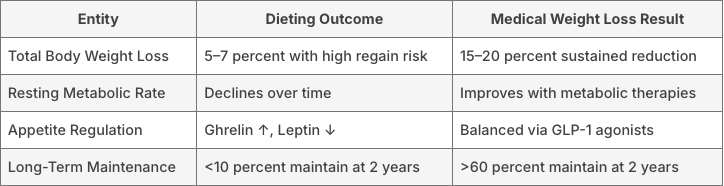
How much difference medication makes
The clearest evidence comes from large clinical trials where everyone received the same diet and exercise counseling, and only half received the medication.
In the STEP 1 trial, adults taking semaglutide lost an average of about 15% of their body weight over 68 weeks. The group that received the same lifestyle program with a placebo lost about 2.4%.
In the SURMOUNT-1 trial, adults taking the highest dose of tirzepatide lost an average of about 21% over 72 weeks, compared with about 3% on placebo.
Those placebo numbers are the closest thing we have to a fair measure of structured dieting alone, and the gap is large. Averages also hide a wide range: some people lose much more, some much less.
How Do Tirzepatide and Semaglutide Enhance Medical Weight Loss at SaltMD?

Both are weekly injections that copy hormones your gut releases after a meal. They slow digestion, reduce appetite and improve how the body handles blood sugar, which makes a smaller amount of food feel like enough.
Semaglutide acts on one hormone receptor, GLP-1. Tirzepatide acts on two, GLP-1 and GIP. In SURMOUNT-5, the first trial to compare them directly in people with obesity, tirzepatide produced greater average weight loss (about 20% versus about 14% over 72 weeks).
That does not make tirzepatide the right choice for everyone. Your clinician considers your health history, how you tolerate the medication and your labs. You can read more on our semaglutide page.
What medication does not do
Medication makes the deficit easier to sustain. It does not make habits unnecessary, and it has limits worth knowing before you start.
It is not suitable for everyone. People with certain personal or family medical histories, or who are pregnant or planning pregnancy, may not be candidates.
Weight tends to return when treatment stops. In the STEP 1 extension, participants regained about two thirds of the weight they had lost within a year of stopping semaglutide. Whether you taper, continue or stop is something to plan with your clinician from the beginning.
Side effects are common early on. Nausea, constipation, diarrhea and reduced appetite are the most frequent, usually in the first weeks and after dose increases. Your clinician starts at a low dose and increases it gradually.
Some of the weight lost can be muscle. Enough protein and regular strength training help preserve it, which is why a nutrition and activity plan stays part of treatment.
Who medical weight loss is for
GLP-1 medications are generally prescribed to adults with a BMI of 30 or higher, or 27 or higher with a weight-related condition such as high blood pressure, prediabetes or sleep apnea. Usually these are people who have already tried diet and exercise and found that the weight does not stay off.
If you are below those thresholds, a lab panel can still be useful. It can show whether something like insulin resistance or a thyroid problem is making progress harder.

How it works at SaltMD
- A 30-minute consultation, in person in Atlanta or by video anywhere in the US.
- Lab work, with blood drawn at a lab near you or at our office. If you have had blood work in the past 90 days, your clinician can review those results instead.
- Your plan. If you are a candidate, your clinician prescribes medication along with nutrition and activity guidance. Your prescription is filled by a partner pharmacy and shipped to you.
- Follow-up. Regular check-ins to adjust the dose, manage side effects and track your labs over time.
Learn more about our medical weight loss program or book a consultation.
Sources
- Wilding JPH et al. Once-weekly semaglutide in adults with overweight or obesity. N Engl J Med. 2021;384:989-1002.
- Jastreboff AM et al. Tirzepatide once weekly for the treatment of obesity. N Engl J Med. 2022;387:205-216.
- Aronne LJ et al. Tirzepatide as compared with semaglutide for the treatment of obesity. N Engl J Med. 2025.
- Wilding JPH et al. Weight regain and cardiometabolic effects after withdrawal of semaglutide: the STEP 1 trial extension. Diabetes Obes Metab. 2022;24:1553-1564.
- Sumithran P et al. Long-term persistence of hormonal adaptations to weight loss. N Engl J Med. 2011;365:1597-1604.
- Centers for Disease Control and Prevention. Obesity prevalence among adults: United States, 2021-2023. NCHS Data Brief No. 508.