Endocrine Society Guidelines for TRT: What to Know

Testosterone prescribing has grown quickly over the past decade, and so has the number of clinics offering it. Some start treatment after a single blood test or on symptoms alone. That makes it worth knowing what the standards actually say, so you can judge whether the care you are offered follows them.
The main reference in the US is the Endocrine Society’s clinical practice guideline on testosterone therapy in men with hypogonadism, published in 2018. The American Urological Association (AUA) has its own guideline, which agrees on most points. Below is what they say about diagnosis, who should not be treated, what treatment aims for and how it should be monitored.
Is the 2018 guideline still current?
Yes. The Endocrine Society lists an update to the 2018 guideline as in development, together with the European Society of Endocrinology. In July 2026 the Society also published a statement that repeats the existing recommendations rather than replacing them.
How low testosterone should be diagnosed
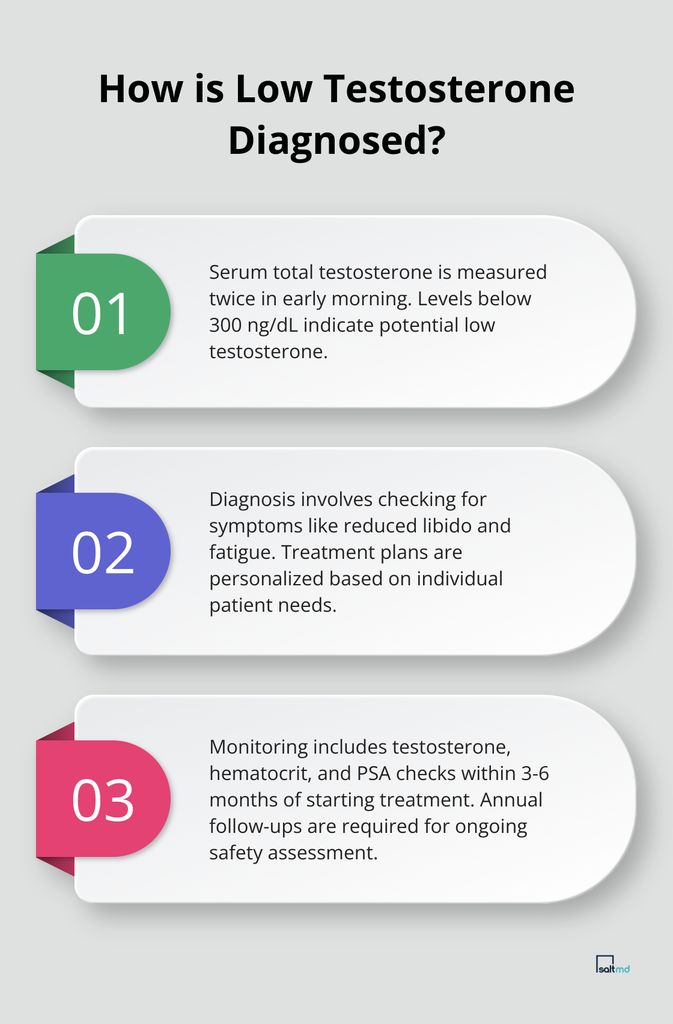
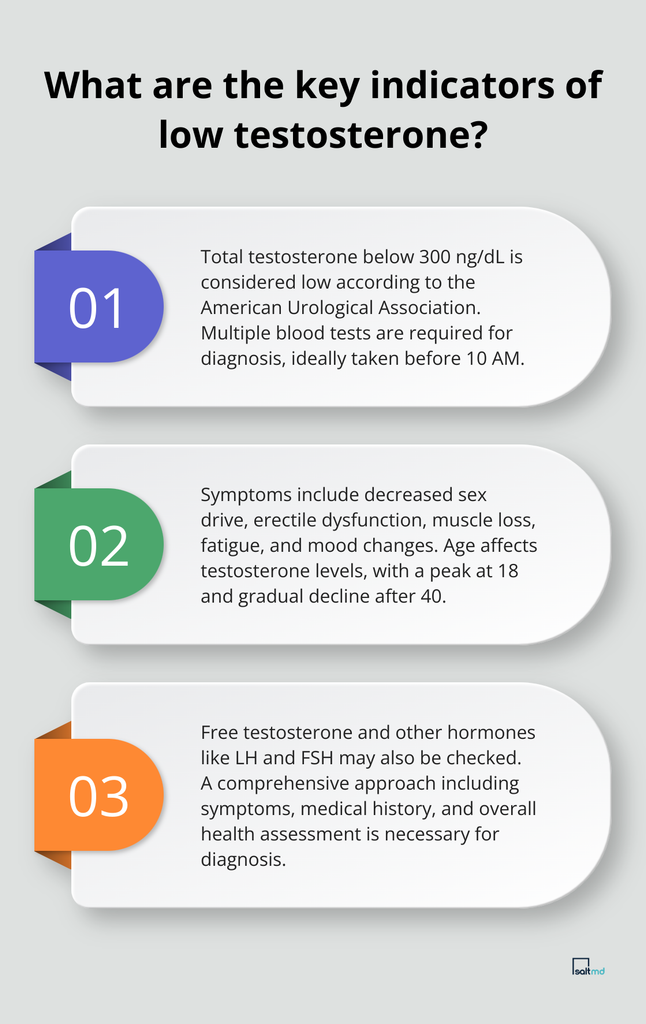
The guideline recommends diagnosing low testosterone only in men who have both symptoms and signs of deficiency and blood tests that are unequivocally and consistently low.
In practice that means:
- Two separate tests, taken in the morning and after fasting, because testosterone levels change through the day and from one day to the next.
- A reliable lab. For labs that are certified against the CDC standard, the guideline uses 264 ng/dL as the lower limit of normal, based on healthy, non-obese men aged 19 to 39. The AUA uses 300 ng/dL as a reasonable cut-off. The two are close, and both require more than one low result.
- Free testosterone in some men, for example when total testosterone is borderline or when conditions affect the protein that carries testosterone in the blood.
- LH and FSH, to find out whether the problem starts in the testes or in the pituitary gland. The answer changes what other tests may be needed.
The guideline does not recommend testing testosterone in men without symptoms.
Who should not start TRT
The guideline recommends against starting testosterone in men who:
- are planning to have children in the near future, because testosterone suppresses sperm production
- have breast or prostate cancer, or a prostate nodule
- have a raised PSA (above 4 ng/mL, or above 3 ng/mL in men at higher risk, such as Black men or men whose father or brother had prostate cancer) without further urological evaluation
- have an elevated hematocrit
- have untreated severe obstructive sleep apnea
- have severe lower urinary tract symptoms
- have uncontrolled heart failure
- have had a heart attack or stroke in the last 6 months
- have thrombophilia, a tendency to form blood clots
It also suggests against routinely prescribing testosterone to all men aged 65 or older who have low levels. In older men, the decision should be made individually, after discussing the potential benefits and risks.
What treatment aims for
The aim is to bring testosterone into the mid-normal range and relieve symptoms. Levels above the normal range add risk without clear benefit.
The guideline does not favor one form of testosterone over another. Gels, injections and other forms each have practical differences, such as how often they are taken and, for gels, the risk of transferring testosterone to a partner or child through skin contact.
Your clinician will explain which form is prescribed and why.
How this applies at SaltMD
Every plan follows the same order the guidelines set out.
- A 30-minute consultation about your symptoms, history and goals, in person in Atlanta or by video anywhere in the US.
- A full hormone panel, with blood drawn at a lab near you or at our office. If you have had blood work in the past 90 days, your clinician can review those results instead.
- A decision. If your results and symptoms confirm low testosterone and none of the reasons above apply, your clinician prescribes treatment. Your prescription is filled by a partner pharmacy and shipped to you.
- Follow-up labs for testosterone, hematocrit and the other markers above, with the dose adjusted as needed.
For a closer look at how treatment works day to day, read How Does Testosterone Replacement Therapy Work? or learn more about TRT at SaltMD.
Sources
- Bhasin S et al. Testosterone therapy in men with hypogonadism: an Endocrine Society clinical practice guideline. J Clin Endocrinol Metab. 2018;103(5):1715-1744. doi:10.1210/jc.2018-00229
- Mulhall JP et al. Evaluation and management of testosterone deficiency: AUA guideline. J Urol. 2018;200(2):423-432. doi:10.1016/j.juro.2018.03.115
- Travison TG et al. Harmonized reference ranges for circulating testosterone levels in men of four cohort studies in the United States and Europe. J Clin Endocrinol Metab. 2017.
- Endocrine Society. Statement on testosterone replacement therapy. July 16, 2026. endocrine.org